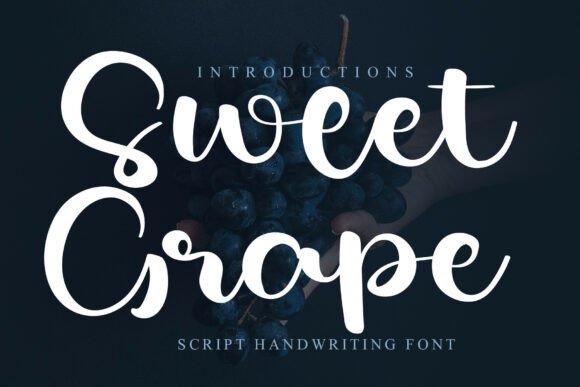
Sweet Grape Font: Modern Handwritten Style for Brands
In the crowded landscape of digital design and physical branding, typography often serves as the primary vehicle for emotional connection. While clean sans-serifs convey efficiency and traditional serifs suggest authority, handwritten fonts occupy a unique space where personality meets professionalism. Sweet Grape represents a specific evolution in this category, offering a stylish and modern handwritten aesthetic that avoids the chaotic illegibility often associated with script typefaces. For designers, marketers, and small business owners, understanding the practical utility of this font goes beyond its visual appeal; it involves recognizing how its technical features and stylistic balance can solve specific communication challenges in branding, packaging, and editorial design.
Balancing Authenticity with Professional Legibility
The most common failure point for handwritten fonts in commercial applications is the sacrifice of readability for style. Many script fonts mimic natural handwriting so closely that they become difficult to parse at smaller sizes or in quick-glance contexts like social media graphics or product labels. Sweet Grape addresses this by maintaining a modern structure that prioritizes clear letterforms while retaining the organic flow of hand-lettering. This balance is critical for entrepreneurs and creators who need their materials to feel personal and approachable without appearing amateurish.
Consider the context of artisanal food packaging or boutique cosmetics. These industries rely heavily on conveying a sense of handcrafted care, yet regulatory requirements and consumer expectations demand high legibility for ingredient lists and brand names. Using Sweet Grape for headlines or primary brand identifiers allows these businesses to inject warmth and a "happiness touch" into their visual identity while ensuring the core message remains accessible. The font’s modern construction ensures it pairs effectively with minimalist sans-serif body text, creating a hierarchy that guides the viewer’s eye naturally from the emotional hook to the informational content.
Leveraging PUA Encoding for Custom Typography
A significant technical advantage of Sweet Grape is its PUA (Private Use Area) encoding. For users unfamiliar with type technology, standard keyboard inputs only access a fraction of a font's potential. PUA encoding maps additional glyphs, alternates, swashes, and ligatures to specific Unicode slots, making them accessible through standard design software like Adobe Illustrator, Photoshop, Canva, and even some word processors without requiring specialized plugin tools.
This feature transforms the font from a static tool into a dynamic design system. When creating a wedding invitation suite or a custom logo, repetition is the enemy of authenticity. Real handwriting never produces two identical letters. By accessing Sweet Grape’s alternate glyphs, designers can vary capital letters, extend swashes on terminal characters, or utilize unique ligatures to create wordmarks that look genuinely bespoke rather than typed. This capability saves considerable time; instead of manually drawing custom lettering or modifying vector paths to achieve a natural look, creators can cycle through pre-designed variations that maintain consistent stroke weight and style. For freelancers and agencies working with tight deadlines, this efficiency directly impacts profitability and project turnaround times.
Practical Applications Across Media Formats
The versatility of Sweet Grape makes it suitable for a wide spectrum of applications, but its effectiveness depends on appropriate contextual use. Understanding where this typeface performs best helps prevent design missteps and maximizes return on investment.
- Greeting Cards and Stationery: This is perhaps the most natural habitat for Sweet Grape. The font’s inherent warmth supports the sentimental nature of personal correspondence. However, the modern edge prevents it from looking dated, making it equally appropriate for Gen Z birthday cards and formal anniversary announcements. The availability of ligatures allows for elegant connections between letters, mimicking the fluid motion of a pen on paper.
- Social Media Content Creation: In feed-based environments where users scroll rapidly, text must be instantly recognizable. Sweet Grape’s bold, confident strokes hold up well against busy photographic backgrounds or solid color blocks. Bloggers and influencers can use it for quote overlays or announcement graphics where the goal is to stop the scroll through visual texture rather than stark contrast.
- Product Packaging and Labels: For small batch producers, packaging is often the only marketing touchpoint. Sweet Grape works exceptionally well for flavor descriptors, limited edition badges, or signature lines on labels. Its stylish nature elevates perceived value, suggesting a premium, curated experience. Because it is PUA encoded, designers can customize the typography for different product variants while maintaining brand consistency across the line.
- Event Branding and Signage: From welcome signs to menu boards, event typography sets the tone before a single word is spoken. Sweet Grape provides the necessary elegance for weddings and galas while remaining friendly enough for corporate retreats or community festivals. Its scalability ensures it remains legible whether printed on a 5x7 place card or a large-format vinyl banner.
Strategic Pairing and Layout Considerations
To maximize the impact of Sweet Grape, it should rarely be used in isolation for extended text. As a display font, its purpose is to attract attention and establish mood. Body copy, legal disclaimers, and detailed instructions are better served by neutral, highly readable typefaces. A practical rule of thumb is to use Sweet Grape for elements comprising fewer than ten words. This restraint preserves its specialness and prevents visual fatigue.
When pairing, consider the x-height and overall proportion. Sweet Grape has a relatively generous x-height for a script, which contributes to its modern feel and readability. It pairs particularly well with geometric sans-serifs that share similar proportions or with clean, low-contrast serifs that provide a stable foundation. Avoid pairing it with other decorative or distressed fonts, as competing textures will create visual noise and dilute the intended message. The goal is to let Sweet Grape serve as the singular focal point of personality within an otherwise structured layout.
Evaluating Fit and Recognizing Limitations
While Sweet Grape offers substantial benefits, it is not a universal solution. Honest assessment of project requirements is essential for successful implementation. This font excels in contexts requiring warmth, approachability, and artisanal quality. It may be less appropriate for highly technical, medical, financial, or legal communications where precision and neutrality are paramount over emotion. In such cases, the playful energy of a handwritten font could inadvertently undermine the seriousness of the content.
Additionally, users should consider their output medium. While Sweet Grape is designed for both print and digital use, intricate ligatures and fine swashes may lose definition at very small sizes on low-resolution screens or when reproduced via certain printing methods like thermal labeling. Always test the specific glyphs you intend to use at the final output size and resolution before committing to production. If your primary application involves tiny text on uncoated paper or pixel-dense mobile interfaces, you may need to opt for simpler alternates or reserve the most elaborate ligatures for larger formats.
For educators and content creators producing materials for accessibility-focused audiences, be mindful that some individuals with dyslexia or visual processing differences find connected scripts more challenging to read than discrete letterforms. In inclusive design contexts, use Sweet Grape sparingly for decorative headers while ensuring all essential information is presented in accessible, non-connected typefaces with adequate spacing and contrast.
Maximizing Creative Efficiency Through Technical Mastery
The true value of Sweet Grape emerges when users move beyond basic typing and engage with its full character set. Investing time to learn glyph panel navigation in your preferred design software pays dividends in creative flexibility. Many designers underutilize PUA-encoded fonts because they are unaware of how to access the extra characters. Tutorials specific to your software platform can unlock this potential quickly, turning what might seem like a technical hurdle into a streamlined creative workflow.
Ultimately, Sweet Grape serves as a bridge between the efficiency of digital typography and the irreplaceable charm of human expression. For professionals and hobbyists alike, it offers a reliable, versatile tool for infusing projects with genuine character. By understanding its strengths, respecting its limitations, and leveraging its technical capabilities, creators can produce work that resonates emotionally while meeting practical demands. The result is design that feels intentionally crafted rather than merely assembled, strengthening the connection between creator and audience in an increasingly automated world.