Daeling Font: Bespoke Elegance for Luxury Branding
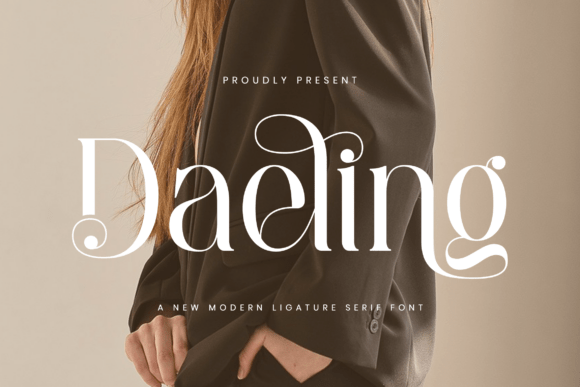
In the competitive landscape of visual identity, typography often serves as the primary differentiator between a generic product and a luxury experience. Daeling is a modern ligature serif typeface designed specifically to bridge this gap, offering designers and brand strategists a tool that communicates prestige through structural refinement rather than mere decoration. Unlike standard serif fonts that prioritize uniformity, Daeling incorporates high-contrast strokes and elaborate circular connections that transform static text into flowing, customized art. For professionals tasked with creating high-fashion editorials, wedding stationery, or bespoke packaging, understanding the practical application of this typeface is essential for achieving a sophisticated aesthetic without sacrificing legibility or workflow efficiency.
Elevating Visual Hierarchy Through High Contrast
The defining characteristic of Daeling is its striking high contrast between thick and thin strokes. In practical design terms, this contrast is not just an aesthetic choice; it is a functional tool for establishing visual hierarchy. When used in headlines or logotypes, the dramatic variation in stroke weight naturally draws the eye to specific letterforms, creating focal points that guide the viewer’s attention. This makes the font particularly effective for luxury product packaging where shelf impact is paramount. A perfume bottle or skincare box utilizing Daeling benefits from this inherent drama, as the typeface carries enough visual weight to stand alone without requiring additional graphic elements or heavy backgrounds.
However, this level of contrast requires thoughtful application. Designers should recognize that high-contrast serifs can become fragile at small sizes or on low-resolution screens. Daeling excels in display settings—typically above 24pt—where the intricate details of the terminals and baseline ornamentation remain crisp. For body copy or digital interfaces requiring extensive reading, pairing Daeling with a clean, neutral sans-serif is recommended. This combination allows the serif to perform its role as a headline anchor while ensuring the overall layout remains accessible and user-friendly. The value lies in using Daeling as a strategic accent rather than a universal solution, preserving its impact for moments where brand elevation is the primary goal.
Streamlining Custom Lettering with Built-In Ligatures
One of the most time-consuming aspects of luxury branding is creating custom wordmarks that feel organic rather than typed. Daeling addresses this challenge through its extensive library of ligatures and alternates. These are not merely decorative add-ons; they are engineered connections that solve spacing issues and create fluid transitions between specific character pairs. For freelance designers and agency creatives, this feature significantly reduces the hours spent manually kerning or drawing custom swashes in vector software. The circular connections and elaborate links are baked into the font file, allowing for rapid iteration during client presentations.
This capability is especially relevant for wedding stationery and invitation design, where personalization is expected. Instead of hiring a hand-letterer for every project, designers can utilize Daeling’s contextual alternates to achieve a similar level of bespoke craftsmanship. The font automatically suggests or allows for the selection of flourishing swashes that adapt to the surrounding letters, ensuring that no two names or phrases look identical. This supports creativity by providing a structured foundation for customization, enabling professionals to deliver high-end results within tighter production timelines. The outcome is a design that feels intentionally crafted for the specific client, strengthening the emotional connection between the brand and its audience.
Technical Accessibility and Workflow Efficiency
A common friction point when working with ornate display fonts is the difficulty of accessing special characters. Many decorative typefaces require specialized plugins or complex glyph panel navigation, which can disrupt the creative flow. Daeling includes PUA (Private Use Area) encoding, a technical specification that maps all special characters, swashes, and ornaments to accessible keyboard shortcuts or standard character map locations. For marketers and small business owners who may not have advanced typographic training, this lowers the barrier to entry. It ensures that the premium features of the font are usable across various design platforms, from Adobe Creative Cloud to Canva, without requiring additional software investments.
This accessibility also future-proofs design assets. When files are shared between team members or sent to print vendors, PUA-encoded characters are less likely to break or revert to default glyphs compared to unencoded extras. For agencies managing multiple luxury accounts, this reliability translates to fewer pre-press errors and smoother handoffs. The practical benefit is a more efficient pipeline where the focus remains on creative direction rather than technical troubleshooting. By integrating these sophisticated elements directly into the font architecture, Daeling supports a professional workflow that values both aesthetic excellence and operational stability.
Strategic Applications in Fashion and Editorial Design
In high-fashion editorials and luxury marketing, typography must convey narrative and mood instantly. Daeling’s exquisite ornamentation on terminals and baselines provides a visual texture that complements photographic content without competing with it. Art directors and publishers can leverage these details to create pull quotes, mastheads, or section dividers that feel integral to the editorial voice. The font’s modern sensibility avoids the stuffiness sometimes associated with traditional serifs, making it suitable for contemporary luxury brands that wish to signal heritage while remaining relevant to younger demographics.
When applying Daeling in editorial layouts, consider the negative space created by its flourishing swashes. These extensions can be used to wrap around images, interact with margins, or create dynamic asymmetry in grid-based designs. This flexibility allows for layouts that break away from rigid templates, supporting a more artistic and immersive reading experience. However, restraint is necessary; because the font is visually rich, overuse can lead to cluttered compositions. Successful implementation involves treating Daeling as a piece of illustration within the typographic system, using it sparingly to punctuate key messages and maintain a sense of exclusive sophistication.
Evaluating Fit and Limitations for Professional Use
While Daeling offers unparalleled elegance for specific applications, it is important to assess whether it aligns with your project’s functional requirements. The font’s personality is distinctly feminine, ornate, and luxurious. It may not be the appropriate choice for tech startups, corporate financial reports, or brands aiming for a minimalist, utilitarian aesthetic. Designers must evaluate the brand’s core values before adoption; if the goal is approachability or stark modernism, Daeling’s elaborate connections might communicate the wrong message. Comparing options against cleaner geometric serifs or humanist sans-serifs is a prudent step in the selection process to ensure the typeface reinforces rather than distracts from the brand identity.
Additionally, users should test Daeling across intended mediums before finalizing licensing. While it performs beautifully in print and high-resolution digital displays, the fine hairlines and intricate ligatures may lose definition on mobile screens or uncoated paper stocks. Conducting legibility tests in the actual production environment helps avoid costly reprints or responsive design failures. For web use, ensuring proper fallback fonts are defined in CSS is critical to maintaining the user experience if the webfont fails to load. By approaching Daeling with a critical eye toward its limitations, professionals can harness its strengths effectively, ensuring that the pursuit of beauty never compromises communication clarity or functional performance.
Ultimately, Daeling represents a convergence of artistry and utility for the modern designer. It solves specific problems related to custom lettering, visual hierarchy, and luxury signaling while streamlining the technical aspects of accessing decorative elements. Whether you are crafting a signature brand identity for a boutique hotel or designing an award-winning magazine spread, this typeface offers a distinct vocabulary for expressing refinement. Its value extends beyond aesthetics, contributing to more efficient workflows and stronger emotional resonance with audiences who appreciate the nuances of bespoke design. By understanding both its capabilities and its constraints, creators can integrate Daeling into their toolkit as a reliable instrument for elevating visual storytelling.