Monte Carlo: Evaluating a Wide Serif for Luxury Branding
In the crowded landscape of display typography, finding a typeface that balances historical reference with contemporary utility is a persistent challenge for designers. Monte Carlo distinguishes itself as an extra-expanded serif that successfully captures the aesthetic of mid-century elegance without feeling like a mere novelty. It is a font designed specifically for high-impact visual communication, offering a distinct alternative to the condensed sans-serifs and standard serifs that dominate current branding trends. For professionals tasked with conveying upscale relaxation or sophisticated heritage, understanding the functional nuances of Monte Carlo is essential before integrating it into a design system.
Defining Characteristics and Visual Mechanics
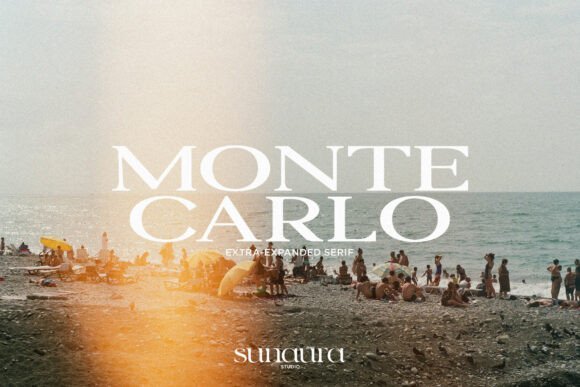
Monte Carlo is defined primarily by its exceptional width. Unlike standard extended fonts that simply stretch existing glyphs, this typeface appears to have been drawn with horizontal expansion as a foundational constraint. The letterforms possess a generous counter space that contributes to an "airy" quality, preventing the bold weight from appearing heavy or oppressive. This openness is critical for maintaining legibility at large sizes, where dense ink coverage can often reduce readability.
The serif structure is refined and deliberate. Rather than adopting the sharp, high-contrast terminals of Didone styles or the robust brackets of Slab serifs, Monte Carlo utilizes clear, moderate serifs that anchor the wide stance of each character. This creates a stable baseline rhythm, which is necessary when setting headlines that span significant horizontal space. The x-height is proportionate to the cap height, ensuring that lowercase letters remain visible and harmonious when mixed with uppercase settings, although the font truly excels in all-caps or small-caps configurations typical of luxury signage and editorial mastheads.
The Mid-Century Connection
The typeface evokes the golden age of travel and hospitality, specifically the 1950s and 1960s era of resort advertising. However, it avoids the cliché script fonts often associated with this period. Instead, it channels the structural confidence of mid-century modernism. This makes it particularly valuable for projects that require vintage credibility but demand modern reproduction standards. The vector construction is clean, avoiding the artificial distressing or texture effects that can limit a font’s versatility across different media.
Practical Applications in Professional Design
Evaluating Monte Carlo requires looking beyond its aesthetic appeal to assess its performance in real-world workflows. Its utility is highly specialized; it is not a workhorse text face, nor is it suitable for UI design or long-form reading. Its value lies entirely in display contexts where immediate emotional resonance is the goal.
- Hospitality and Resort Branding: This is the primary use case. The width suggests spaciousness and leisure, psychologically reinforcing the promise of a luxury experience. It works exceptionally well on welcome signage, poolside menus, and hotel stationery where the brand voice is calm yet confident.
- Editorial and Fashion Layouts: In magazine design, Monte Carlo serves as an effective contrast to dense body copy. Its expansive nature allows art directors to create dynamic asymmetrical layouts. When used for pull quotes or section headers, it breaks the grid effectively without disrupting the overall hierarchy.
- Vintage Travel and Event Collateral: For posters, tickets, and invitations, the font provides instant period-appropriate styling. Because it is a digital revival rather than a scanned artifact, it scales perfectly for everything from social media graphics to large-format billboards.
- Packaging for Premium Goods: Spirits, cosmetics, and gourmet foods often rely on wide serifs to suggest established quality. Monte Carlo fits this niche by offering a label presence that feels expensive and unhurried.
Technical Considerations and Workflow Integration
When incorporating Monte Carlo into a project, technical awareness is just as important as stylistic choice. The extra-expanded width has significant implications for layout and typesetting. Designers must account for the substantial horizontal footprint; what fits comfortably in a standard serif may require three times the width in Monte Carlo. This necessitates careful planning during the wireframing stage to avoid awkward line breaks or excessive hyphenation, both of which undermine the luxurious feel the font intends to convey.
Kerning and tracking adjustments are frequently required. While the default spacing is generally competent, the unique geometry of wide serifs means that certain letter combinations (such as 'AV', 'WA', or 'LY') may need optical correction to maintain even color. Conversely, adding slight positive tracking to all-caps settings can enhance the sense of airiness and improve legibility at smaller display sizes. Professionals should test the font at various output resolutions early in the process, as the fine details of the serifs can behave differently on uncoated paper versus glossy stock or digital screens.
Pairing Strategies
Because Monte Carlo carries such strong personality, pairing it requires restraint. It demands a supporting cast that is neutral and structurally simple. Geometric sans-serifs like Futura or Century Gothic complement its mid-century roots without competing for attention. Alternatively, a clean neo-grotesque like Helvetica Now or Inter provides a modern counterpoint that grounds the historical references. Avoid pairing Monte Carlo with other serifs or decorative scripts, as this typically results in visual clutter and dilutes the impact of the primary display face.
Evaluating Value and Limitations
For freelancers, agencies, and in-house teams, the decision to license or use Monte Carlo should be weighed against project longevity and scope. Its strength is also its limitation: it is unmistakably stylized. A brand built entirely around this aesthetic risks appearing dated if the broader design trend shifts away from retro-luxury. Therefore, it is often most effective when used as an accent within a broader, more flexible identity system rather than as the sole typographic voice.
Despite this specialization, the execution quality offers significant long-term value. Many free or low-cost "vintage" fonts suffer from poor hinting, incomplete character sets, or inconsistent stroke weights. Monte Carlo presents as a professional-grade tool with the reliability required for commercial print and digital production. For designers who frequently service clients in the lifestyle, travel, or fashion sectors, having a dependable, high-quality wide serif in their toolkit reduces the time spent searching for suitable alternatives and mitigates the risk of using subpar assets.
Audience Fit and Strategic Recommendation
Determining whether Monte Carlo is the right asset depends heavily on the specific communication goals of the project. It is ideally suited for marketers and creators targeting an adult demographic that associates width and serif refinement with stability, exclusivity, and leisure. If the objective is to communicate urgency, technology, or grassroots authenticity, this typeface will likely send the wrong signal. However, for projects aiming to elevate perceived value through typographic association, it performs reliably.
Small business owners and entrepreneurs should consider Monte Carlo if they are positioning their offerings in the premium tier. The font does the heavy lifting of establishing tone before a customer reads a single word of copy. Educators and students of graphic design will also find it a useful case study in how proportion influences mood; analyzing its metrics provides insight into the relationship between negative space and perceived luxury.
Ultimately, Monte Carlo earns its place in the professional typographic canon not merely by looking beautiful, but by solving a specific communication problem. It bridges the gap between nostalgic warmth and modern clarity. For those working in spaces where atmosphere is as important as information, it offers a sophisticated, reliable solution that respects both the history of the genre and the practical demands of contemporary design. When applied with intention and technical care, it transforms standard layouts into immersive brand experiences that resonate with discerning audiences.